In October 1707, a proud British Royal Navy fleet under Admiral Sir Clowdisley Shovell struck the treacherous rocks of the Scilly Isles in thick fog. Four mighty warships were destroyed, and nearly two thousand sailors perished within minutes. The disaster was not caused by enemy cannon fire or mutiny; it was caused by a fatal mathematical blindness. For centuries, navigators could easily measure their latitude north or south, but calculating longitude east or west at sea remained an impossible, deadly mystery that claimed thousands of ships and fortunes.
Executive Historical Summary
- The Mathematical Core: Longitude is time. Because Earth rotates 15 degrees per hour, knowing the exact time difference between your local ship noon and a fixed reference meridian (Greenwich) directly yields your east-west longitude.
- The Longitude Act of 1714: The British Parliament offered an unprecedented prize of £20,000 (worth several million dollars today) for any method determining longitude to within half a degree after a 6-week voyage to the West Indies.
- The Rivalry: Academic astronomers insisted the answer lay in the stars (the Lunar Distance method), declaring that a mechanical clock could never survive the violent pitching, humidity, and temperature swings of ocean navigation.
- John Harrison’s Triumph: A self-taught Yorkshire carpenter spent four decades perfecting four sea-clocks (H1 to H4). His 1759 pocket chronometer H4 lost just 5.1 seconds over 81 days at sea, revolutionizing maritime navigation forever.
Table of Contents
- 1. The 1707 Scilly Naval Disaster: The Catastrophic Cost of Dead Reckoning
- 2. Why Longitude Is Time: The 15-Degree Celestial Geometry
- 3. The Longitude Act of 1714: A Royal Challenge
- 4. The Astronomical Path: Maskelyne and Lunar Distances
- 5. John Harrison’s Masterpieces: From H1 to the H4 Pocket Chronometer
- 6. The Trial at Sea and the Battle with the Board of Longitude
- 7. Frequently Asked Questions (FAQ)
- 8. Conclusion & How Harrison Unlocked the World Ocean
1. The 1707 Scilly Naval Disaster: The Catastrophic Cost of Dead Reckoning
On the foggy night of October 22, 1707, twenty-one Royal Navy warships under Admiral Sir Clowdisley Shovell were returning to England from the Mediterranean. Navigating by dead reckoning—estimating position based on compass headings, wind leeway, and knotted rope speed measurements—the fleet’s navigators believed they were safely entering the English Channel.
In reality, ocean currents had pushed the fleet far off course to the west. The flagship HMS Association struck the jagged granite reefs of the Isles of Scilly, sinking in under four minutes. Three more warships (Eagle, Romney, and Firebrand) followed onto the rocks. Nearly 2,000 sailors, including the Admiral himself, perished. The national trauma convinced the British Crown that oceanic navigation had to be saved from guesswork.
2. Why Longitude Is Time: The 15-Degree Celestial Geometry
Determining latitude (north-south) was simple: mariners used cross-staffs and astrolabes to measure the angle of the North Star (Polaris) above the horizon or the altitude of the sun at midday. If Polaris was 30° above the horizon, the ship was at 30° North latitude.
Longitude (east-west) was vastly more elusive because the Earth is constantly spinning. To know where you are east or west, you must compare two different times simultaneously:
The Longitude Formula:
- Local Ship Time: Determined by observing when the midday sun reaches its highest altitude (12:00 Local Solar Noon).
- Reference Base Time: A portable clock carried aboard showing the exact time back at Greenwich, London.
- Calculation: Every 1 hour of time difference = 15° of Longitude (or 4 minutes per 1 degree).
If your local noon occurs when your clock shows 3:00 PM Greenwich time, you are 3 × 15° = 45° West Longitude. However, an error of just two minutes in the clock’s reading translates to an error of 30 nautical miles at the equator—more than enough to smash a ship against unseen coastal shoals.
3. The Longitude Act of 1714: A Royal Challenge
Stung by naval losses and petitioning from maritime merchants, Queen Anne signed the Longitude Act of 1714. Parliament established the Board of Longitude and offered a monumental graduated reward:
- £10,000 for a method determining longitude within 1 degree (60 nautical miles).
- £15,000 for determining longitude within 40 arcminutes.
- £20,000 (worth over £3.5 million in modern currency) for determining longitude within half a degree (30 nautical miles) after a transatlantic voyage to the West Indies.
4. The Astronomical Path: Maskelyne and Lunar Distances
The scientific establishment, including Sir Isaac Newton and Astronomer Royal Nevil Maskelyne, believed that no mechanical clock could maintain accuracy at sea. Pendulums were rendered erratic by rolling waves; oils coagulated in arctic freezing weather and liquefied in tropical heat; brass gears expanded and warped.
Maskelyne championed the Lunar Distance Method: using the moon as a giant celestial clock against background stars. While theoretically sound, it required expensive sextants, clear night skies, dense almanac tables (the Nautical Almanac, published from 1767), and roughly four hours of complex spherical trigonometry calculations by hand—conditions impossible during ocean storms.
5. John Harrison’s Masterpieces: From H1 to the H4 Pocket Chronometer
Into this intellectual battlefield stepped John Harrison, an uneducated carpenter and clockmaker from Foulby, Yorkshire. Disregarding academic skepticism, Harrison was convinced that mechanical horology could conquer the sea. Over forty years of relentless genius, he created four iconic machines:
- H1 (1735): A massive 75-pound brass sea-clock utilizing counterbalanced dumbbell balances connected by brass wires, immune to the ship’s roll.
- H2 (1741) & H3 (1757): Incorporated Harrison’s revolutionary invention of the bi-metallic strip (bonding brass and steel so differential thermal expansion compensated for temperature shifts) and caged roller bearings to conquer friction without lubrication.
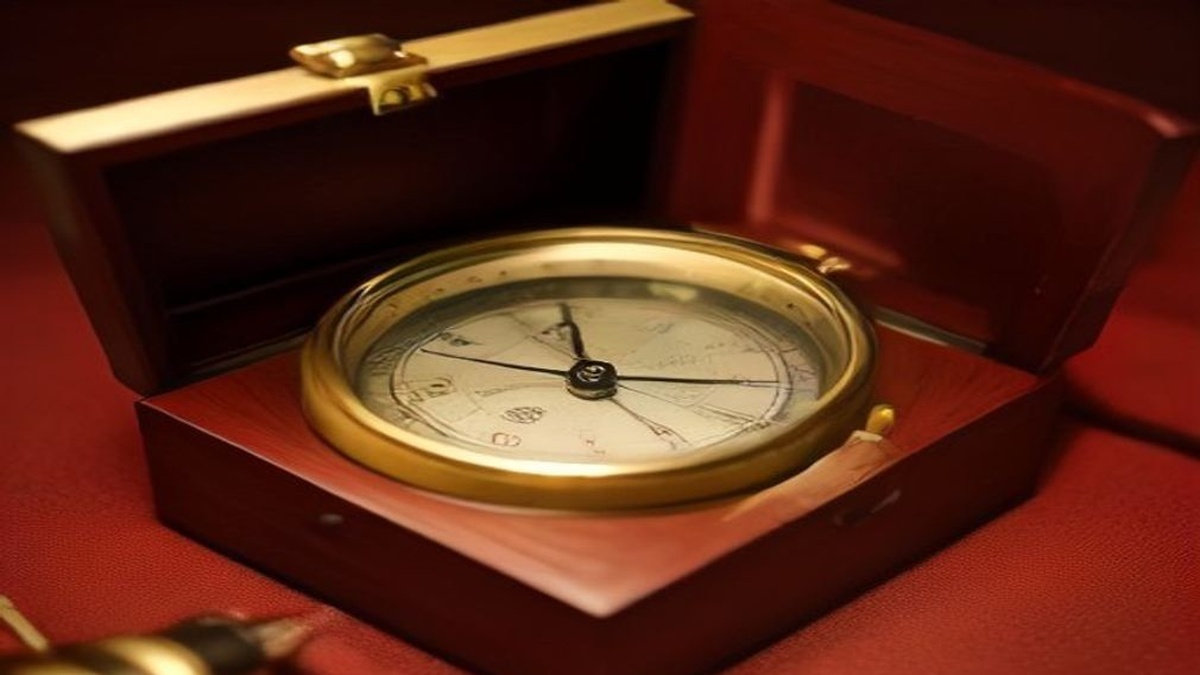
- H4 (1759): Harrison’s masterstroke. Abandoning the colossal sea-clock paradigm, Harrison miniaturized his mechanisms into a magnificent 5.2-inch silver-cased pocket watch chronometer, featuring diamond pallet stones and an ultra-fast balance oscillating at 5 beats per second.
6. The Trial at Sea and the Battle with the Board of Longitude
In November 1761, Harrison’s son William boarded HMS Deptford bound for Jamaica with H4. After 81 brutal days navigating stormy Atlantic seas, H4 arrived in Jamaica having lost an unbelievable 5.1 seconds—corresponding to an error of only 1.25 nautical miles, far surpassing the Act’s strictest criteria!
The academic Board of Longitude, dominated by astronomers, refused to hand over the full £20,000, claiming the result was fluke luck and demanding further trials. Outraged by the bureaucracy, Harrison appealed directly to King George III in 1772. The King personally tested Harrison’s H5 timepiece at his Kew observatory, finding it accurate to within one-third of a second per day, famously declaring: “By God, Harrison, I will see you righted!” Parliament finally paid Harrison his full reward in 1773, when the master was 80 years old.
7. Frequently Asked Questions (FAQ)
Q1: How did Captain James Cook verify Harrison’s chronometer?
A: On his famous second voyage to the Pacific (1772–1775), Captain Cook carried K1, an exact copy of Harrison’s H4 built by Larcum Kendall. Cook hailed it as his “never-failing guide,” charting the Pacific Ocean and Antarctica with unprecedented cartographic accuracy.
Q2: Where are Harrison’s original timepieces kept today?
A: Harrison’s H1, H2, H3, and H4 timepieces are preserved, beautifully restored, and on public display at the Royal Observatory in Greenwich, London.
8. Conclusion & How Harrison Unlocked the World Ocean
John Harrison’s marine chronometer did not merely win a monetary prize; it opened the world’s oceans to safe global navigation, accelerated the Age of Discovery, and propelled maritime cartography into the modern scientific era. In the intersection of clockwork and astronomy, Harrison proved that the most complex celestial dilemmas can be solved by humble mechanical perseverance.